Beyond the Assembly Line: Why Automation and Robots Replace Tasks, Not Designers
Are designers like assembly line workers, bound to be replaced by robots? I asked myself this after I read this quote from Jak Connor: “Apple reportedly told managers that it wants the final assembly line headcount reduced by as much as 50% over the next few years” [1]. As robotic technology continues to progress, designers are asking themselves if they are next in line to have their job replaced by a robot.
The Purposes of Design
A designer is someone who cares enough about a problem to take on the challenge of:
Creatively identifying and analyzing the root causes and constraints of a problem
Intentionally choosing an appropriate plan and guiding that plan into action
Repeating this process until the problem is solved or resources run out
There are many different kinds of designers. One thing that unifies designers right now is that many of them are worried that their jobs will be replaced by robots, or rather AI versions of themselves. In this article, we will explore what design is and why we as people do not need to fear AI taking over our work as designers. We must respect AI because of its potential ability now and especially in the future to do the work similar to humans who call themselves designers, but AI cannot replace real design.
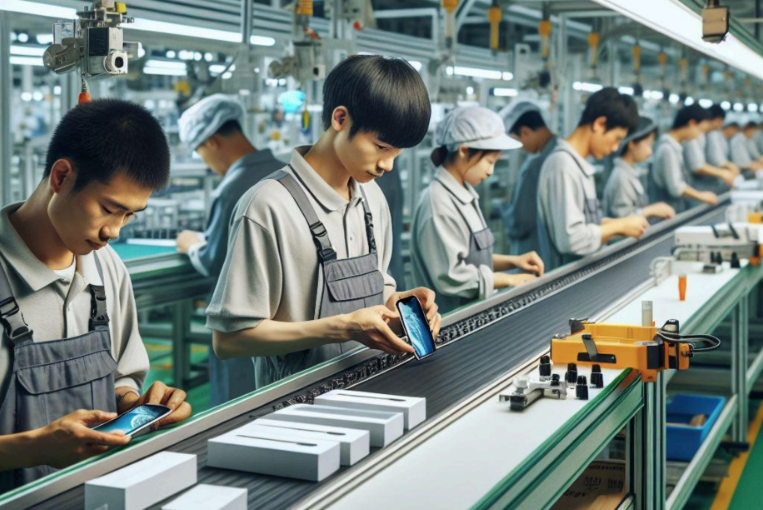
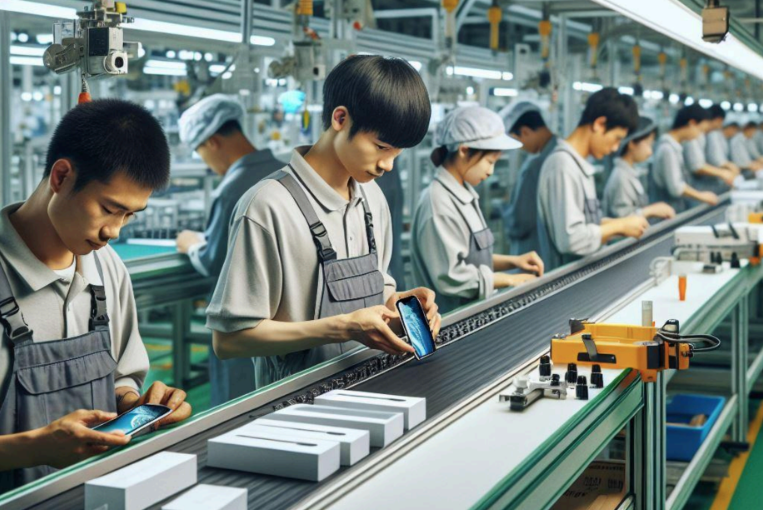
Figure 1: An image of assembly line workers generated by Microsoft Copilot by the author.
““What a computer is to me is it’s the most remarkable tool that we’ve ever come up with, and it’s the equivalent of a bicycle for our minds” ”
AI is the next great tool
Assuming Steve Jobs was right, and a computer is the bicycle for the mind, then I would call AI the self-driving E-bike for the mind. E-bikes allow the human already on the bicycle to amplify their effort. An E-bike does not necessarily require human legs to push it to superhuman speeds, but they do need the human to do more than carry them up the stairs and plug them into the wall. They still need humans to desire them to go somewhere. So the AI is useless to itself without humans. After all, if the AI creates a von Neumann probe in the forest and no one is there to fear it, did it truly self-replicate?
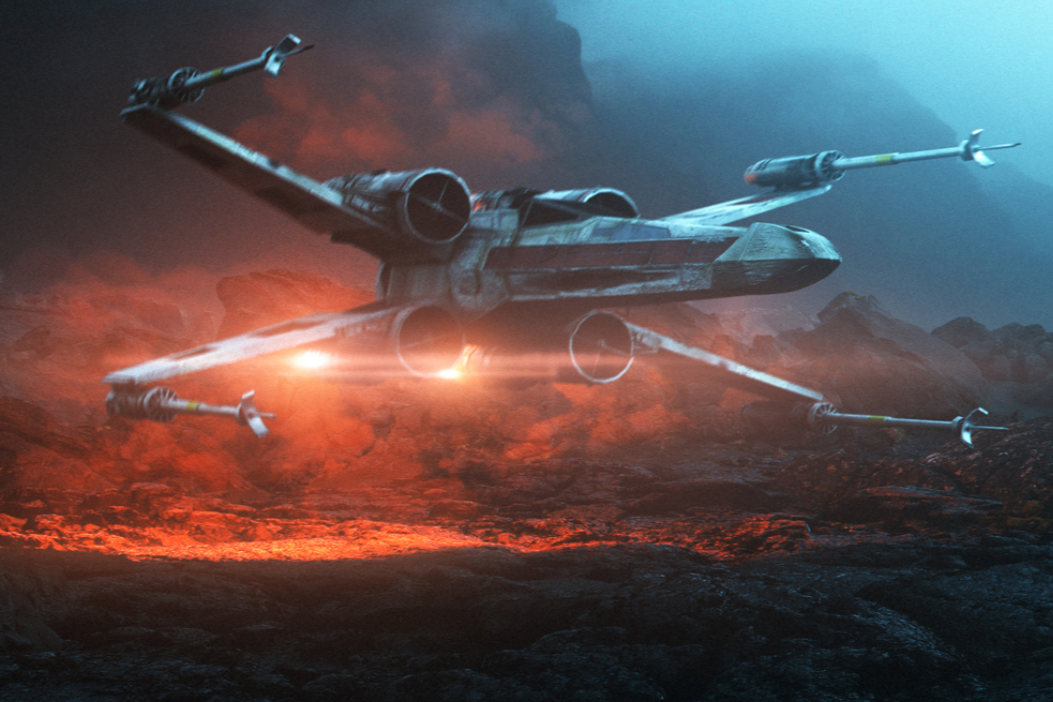
So it is with design. The AI I used to create the header image for this paper did not create the photo I was thinking of all on its own. It was my need plus the AI’s skills that created the image.
This is when those who are performing artistic technical labor might feel disheartened. The last thing people want to hear is that their most refined skills are suddenly common. Creatives may begin rationalizing that machines could never take over their jobs, saying whatever excuse they can come up with to get them to believe they will always be invaluable because they are an expert in Photoshop, Blender, Indesign, Revit, etc. But, I would argue that even the most complicated tasks that most of us do in a computer program could in time be automated by AI.
Empathy and Design
So does that not mean that AI will take over as the designer? In the definition I proposed for a designer at the beginning of the paper, I specified that the designer is the one who cares. AI, because of its ability to create incredibly helpful outputs, may, by some, get called a designer, but I don’t agree with this categorization. A designer must understand and have empathy for the audience they are designing for. As Chris Mattson put it in “Design Thinking Part 2: Design Thinking as a Step-by-Step Process” he said, “To empathize means to understand and share the feelings of another person … This part of the Design Thinking process is a key ingredient of innovation” [3]. If a designer does not have empathy for a group then they will struggle to do real design. AI can learn more than a single human ever could about a problem, but because it never truly cared about humans it will never be able to design what a human would.
What are Humans Best at?
Most of us have come to terms with the idea that assembly line workers can readily have their jobs replaced by robots. Robots are currently being trained to solder, inspect, package, ship, and do anything else needed on an assembly line, and they seem to be doing it quite well. In nature it seems human’s efforts are always being outperformed by non-human entities. Before Steve Jobs’s words about the bicycle he said “I read a study that measured the efficiency of locomotion for various species on the planet. The condor used the least energy to move a kilometer. And, humans came in with a rather unimpressive showing“ [2]. It seems a human on foot can easily be outrun by a cheetah and a human on an assembly line can easily be outpaced by a robot. Jobs continued by saying, “I think one of the things that really separates us from the high primates is that we’re tool builders” [2]. So it is with the things we currently enjoy doing on a computer. We do design tasks by hand on a computer currently, but in the future much or all of this could be automated with AI.
AI Bringing Design Tools to a Larger Audience
I have already experienced coming home to a 15 year old with professional quality clip-art he generated with his friends for his new T-shirt business. It took him a lot of trial and error, due to our current AI models. That did not stop him from producing the clip-art, which he would have been unable to make on his own due to his current artistic abilities. AI is allowing him to create a business and is enabling him to be a T-shirt designer. His T-shirt business may not change the world in a significant way, but it is a simple example of how AI allows people to be designers and create impact in the world which may not have otherwise happened.
To be clear, I am not saying we should stop learning Onshape, Indesign, Illustrator or any other design program. I will continue to pour many of my hours into learning similar programs to these for the foreseeable future. What I am trying to say is AI will not ruin design as a field. It will simply bring it to everyone.
Take what happened to the photography industry for example. I bought my first DSLR (Digital Single-Lens Reflex Camera) in 2013 and I later embarked on the journey of learning manual photography. I love using a “real camera” as I call them to do my photography. But, when I hand my camera to anyone unfamiliar with a camera like this it usually takes a great deal of explanation or I get a blurry picture of myself such as this example in Washington state as seen in Figure 2.

Figure 2: A blurry photo of the author at Deception Pass Strait in Washington State.
Smartphones have allowed for anyone to be a photographer. They do all the background work so that the user can just focus on the part the phone can’t do. Up until the smartphone, proportionally few people brought a camera everywhere with them or even owned a camera, as shown by Figure 3. Now, it is hard to imagine going anywhere interesting without people trying to be amateur photographers and take pictures of nearly everything to share with those in their lives.
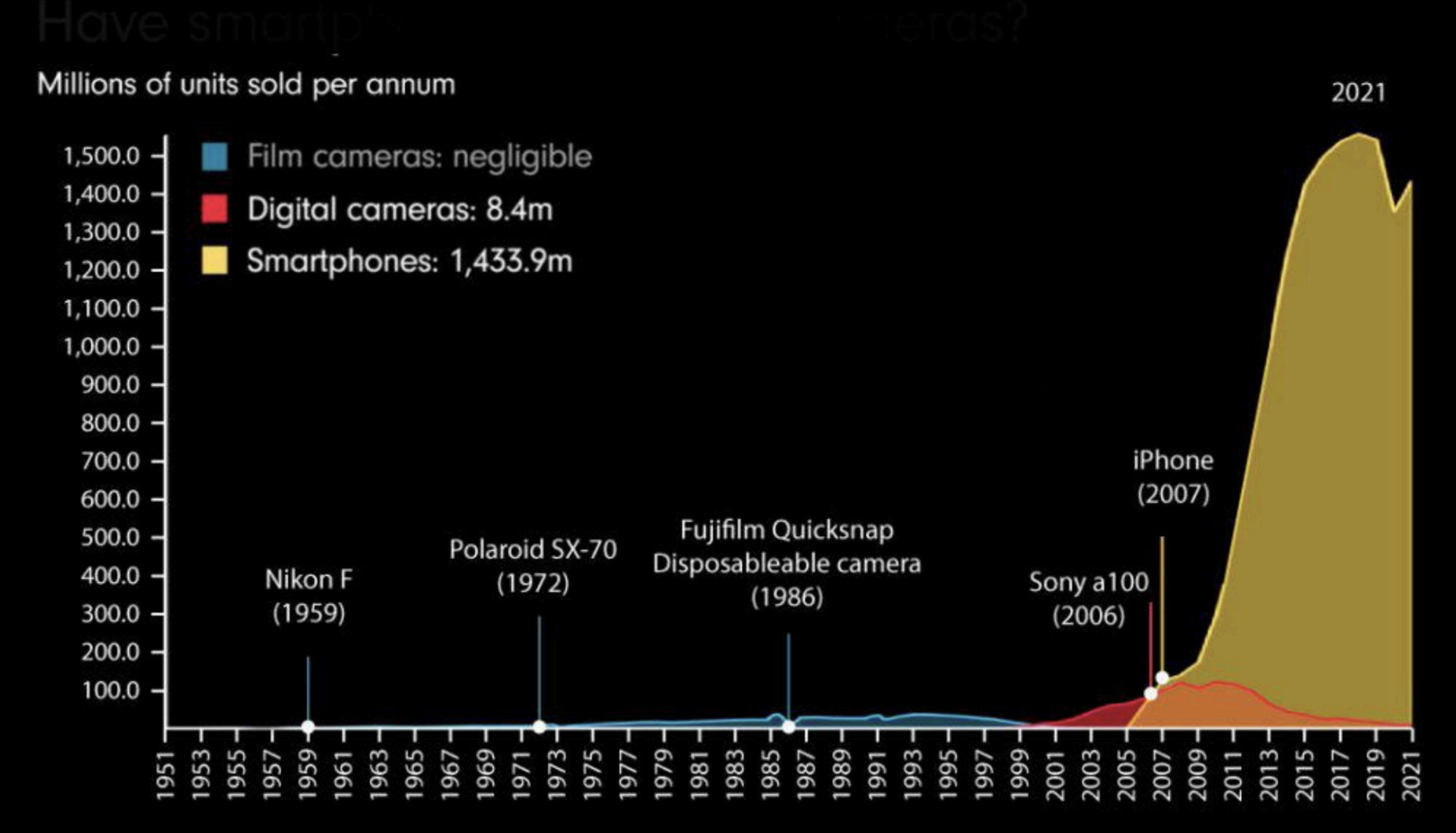
Figure 3: Graph depicting cameras sold from 1951 to 2021 from “Technology Animated Chart: The Smartphone Effect on the Camera Market” Published December 28, 2022 By James Eagle [4].
This same sort of rapid growth is what could happen with any other design tool with the help of AI. Every banker, construction worker, or elementary school teacher could one day be a capable sketcher, 3D modeler, manufacturer, marketer, whateverer with the help of AI. If they needed a skill to fulfill their role as a designer they could have access to it. With a world full of wicked problems, as Horst Rittel and Melvin Webber, called them in their paper “Dilemmas in General Theory of Planning” [5]. Giving every person the opportunity to be a capable designer might allow for the formulation of solutions to some of our greatest world challenges. And birth to a new age of design.
What Does it Mean to Design?
In an interview I conducted with Ben Murdoch, AI research engineer at Google, he said, “to design is to love.” He continued by saying that to design is to spend some amount of “your finite existence” creating something that didn’t exist before. This may be one of the unique things that differentiates us from the robots which take part in design execution. Many technicians, human or robot, will continue to be brought onto projects and these actors may call themselves designers. However, I am offering that someone is a designer because they are the one that really cares about their project, or more importantly cares about the people who will be impacted by the design solution. In the future, in order to create bigger, cheaper, more complicated designs, we will be incorporating AI. It will be used to do many tasks human employees currently do today, but still these algorithms will not be designers. No, the designer stays the human with the unique qualification of being the loving toolmaker [2].
References:
[1] Connor, Jak. "Apple Greenlights Replacing 50% of iPhone Final Assembly Line with Automation." TweakTown, 24 June 2024, https://www.tweaktown.com/news/98986/apple-greenlights-replacing-50-of-iphone-final-assembly-line-with-automation/index.html.
[2] Popova, Maria. "Steve Jobs on Why Computers Are Like a Bicycle for the Mind (1990)." The Marginalian, 21 Dec. 2011, https://www.themarginalian.org/2011/12/21/steve-jobs-bicycle-for-the-mind-1990/.
[3] Mattson, Chris. "Design Thinking Part 2: Design Thinking as a Step-by-Step Process." The BYU Design Review, https://www.designreview.byu.edu/collections/design-thinking-part-2-design-thinking-as-a-step-by-step-process.
[4] Eagle, James. "Animated Chart: The Smartphone Effect on the Camera Market." Visual Capitalist, 28 Dec. 2022, https://www.visualcapitalist.com/cp/charting-the-smartphone-effect-camera-market/.
[5] Rittel, Horst W. J., and Melvin M. Webber. "Dilemmas in a General Theory of Planning." Policy Sciences, vol. 4, no. 2, June 1973, pp. 155-69. Springer Link, https://link.springer.com/article/10.1007/BF01405730.
Read More:
AI can only produce artificial creativity - ScienceDirect
https://petapixel.com/2015/04/09/this-is-what-the-history-of-camera-sales-looks-like-with-smartp hones-included/
Will AI replace graphic designers? Predicting the future of graphic design
The Real Threat From ChatGPT Isn’t AI…It’s Centaurs | PCGamer | February 13, 2023 | Kasparov
What is Artificial Intelligence? - GeeksforGeeks
Problem Solving in Artificial Intelligence - GeeksforGeeks
To cite this article:
Murdoch, Tom. “Beyond the Assembly Line: Why Automation and Robots Replace Tasks, Not Designers.” The BYU Design Review, 11 May 2026, https://www.designreview.byu.edu/collections/beyond-the-assembly-line-why-automation-and-robots-replace-tasks-not-designers.