Why All Creative People Should Read Books
Consider for a moment what comes out of the innovator’s mind. The degree to which it is good and valued has a lot to do with (i) what goes into the one’s mind and (ii) how one assembles new ideas from conscious and sub-conscious elements within it.
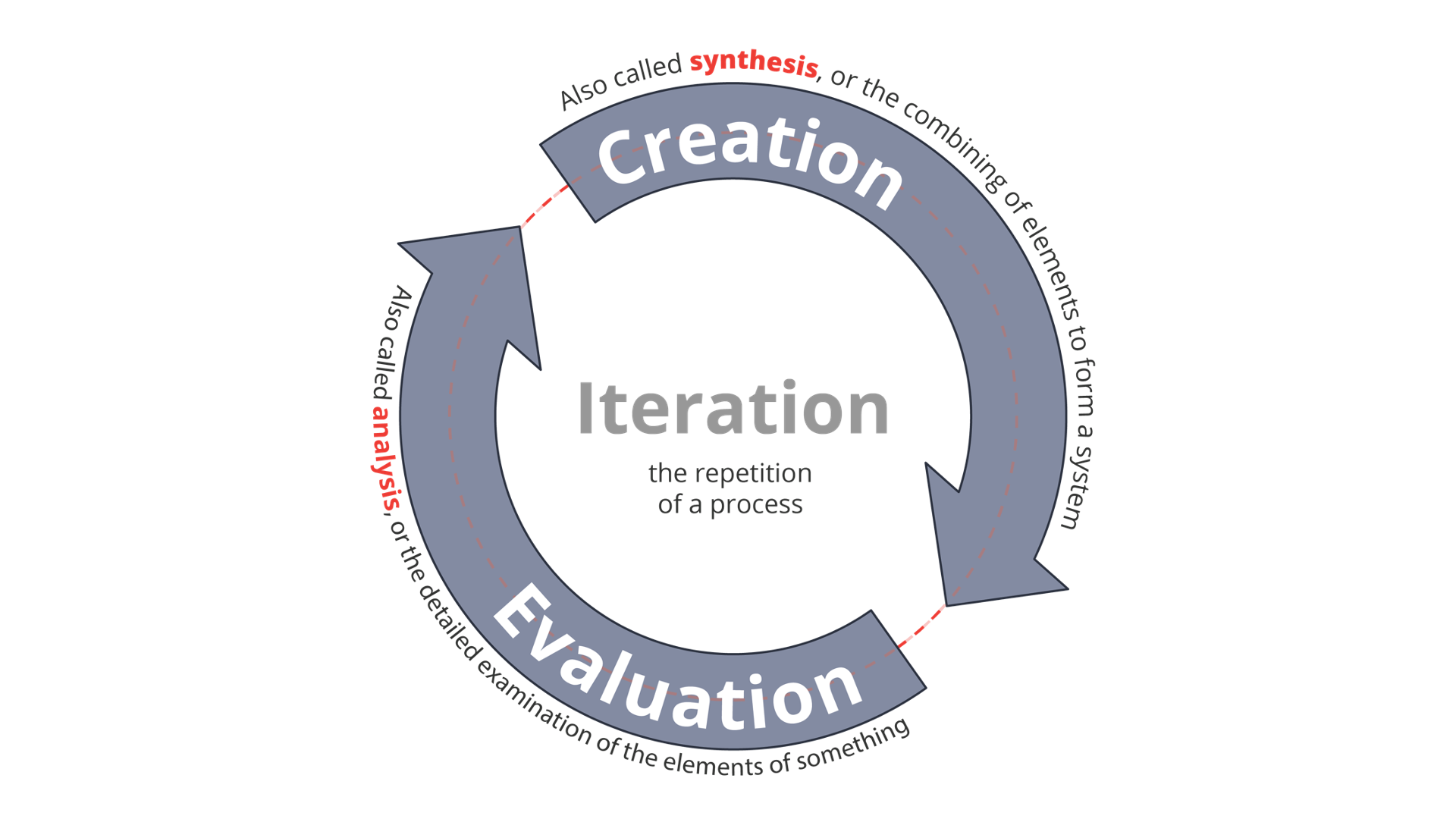
The BYU Design Review has numerous articles on assembling new ideas from (existing) elements – this is called synthesis [1-3]. The image below shows the critical role that synthesis plays in the basic definition of design.
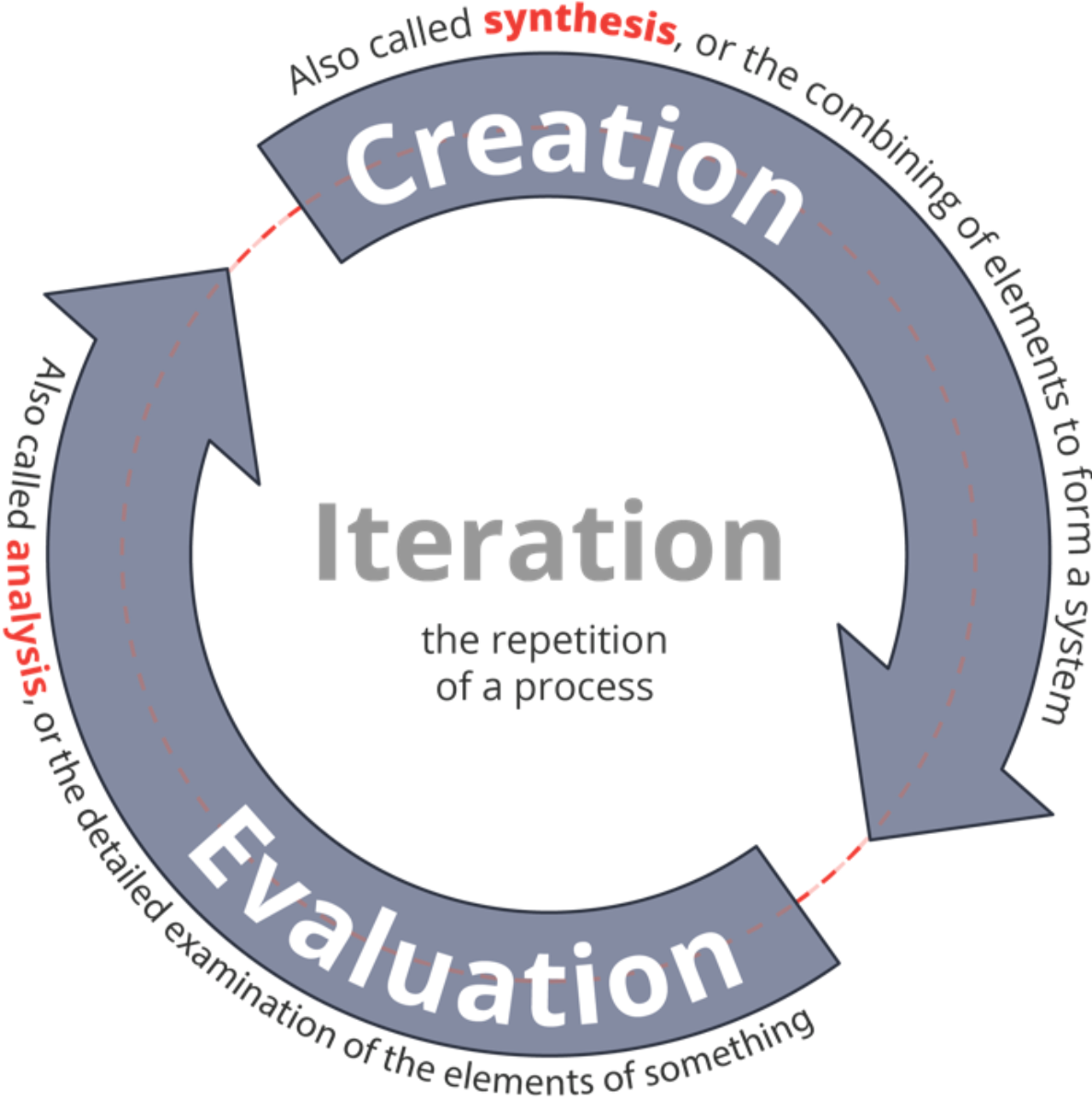
Figure 1: The iterative process of evaluation and creation. Schematic by the author.
Rather than focusing on synthesis, this article instead considers what goes into the innovator’s mind – specifically, through reading.
Numerous studies have shown that reading has a significant positive impact on creativity [4-6]. Reading strengthens creativity by exercising imagination, exposing readers to new ideas and perspectives, and forcing the mind to actively construct meaning rather than passively receive it. Reading engages multiple areas of the brain, supports critical and creative thinking, and is empirically associated with stronger creative performance among people who read more frequently [5].
For designers and engineers, this matters because reading does not just inspire ideas — it builds the mental habits needed to think beyond familiar patterns and generate more thoughtful, original solutions [7, 8].
In recent years I have significantly increased the amount of reading I do outside of my workplace, and it has substantially expanded my world view and the way I approach problems that involve creative solutions. If I think back to times in the past when I was not reading as much, I can see that those were times when I was locked into my own way of thinking without regard to the rest of the world. If you are even remotely close to this, I provide below two ways to kickstart a deeper commitment to reading, and I provide of list of eleven books I have recently read – in case you want a suggestion from someone with similar interests.
Two Ways to Kickstart a Deeper Commitment to Reading
A handful of years ago I noticed that John Salmon (The BYU Design Review Co-Founder) was reading a lot of books (e.g., Cal Newport’s Deep Work). When I asked him about it, he said, “I decided to invest in myself and get an Audible account.” I promptly followed his example and have since “read” dozens of books. For me, it was well worth the cost and is something I recommend others consider, or find an alternative such as checking out audiobooks from your local library.
Similarly impactful as the Audible account was that I joined a book club. At first this was an experiment, but after reading half a dozen books together, I now consider it a solid practice. It is particularly interesting to read a book that someone else suggests (e.g., When Breath Becomes Air by Paul Kalanithi — an amazing true story of dying, as told by a neurosurgeon) and then discuss it in a group. I recommend joining or starting a book club. One book per quarter is a good starting spot.
What I Have Read Recently
If you are not sure what to read, consider the following, which I have listed in rough order of how much I liked them.
1 - Everything Is Tuberculosis: The History and Persistence of Our Deadliest Infection
Author: John Green — 2025
Why I liked it: First of all, John Green is an amazing and thought-provoking author whose words are easy and fun to read. This book is a historical perspective full of well-supported facts on why tuberculosis is so deadly despite humanity having the knowledge to mitigate it. It is a fascinating book that hits right at the center of some of my professional research — global development, social impact, and health systems. Green paints a vivid picture of global healthcare, arguing that we generally solve the problems we are interested in solving, including COVID-19, but not tuberculosis, the world’s deadliest infectious disease. The book is really about the social structures that cause one disease, but not another, to receive resources for mitigation. It is just plain interesting.
2 - The Creative Act: A Way of Being
Author: Rick Rubin — 2023
Why I liked it: Surprisingly, my hairstylist recommended this book to me. He thought I would like it, and he was right. It has made me think more deeply about my current creative process and what it could become. This book is very Zen. It does not try to be exact, repeatable, or prescriptive, which makes it quite different from pretty much everything else I read (books and otherwise). What I like about it is that even though Rubin speaks from the perspective of the music industry and record producing, it resonates strongly with my own personal and professional creative pursuits. In a unique and welcome way, he ends each chapter with a single inspiring phrase, such as “Living in discovery is at all times preferable to living through assumptions,” or “Maybe the best idea is the one you’re going to come up with this evening.” There are dozens of these thought-provoking chapter endings. I have never read a book like this before and cannot really compare it to anything else, but it is inspiring.
3 - The Anxious Generation: How the Great Rewiring of Childhood Is Causing an Epidemic of Mental Illness
Author: Jonathan Haidt — 2024
Why I liked it: It is important to try to understand how different people experience the world. This book was very enlightening in that way. Because I am the father of young adults, and because I interact daily with young adults, I came away with significantly more empathy for those described as the anxious generation. This book essentially tracks how free and unstructured playtime was negatively affected by a simple campaign about “stranger danger”, which was later exacerbated by the very real threat of online vulnerability and abuse. For the generation that experienced that (and other things), the way relationships are formed and valued has changed. Particularly poignant is the concept that relationships are easily formed (subscribing) and easily broken (unsubscribing). The data in this book helped me see the world differently. Interestingly, after speaking with various people about this book and asking about Jonathan Haidt’s other works, multiple people told me they loved The Anxious Generation but cared less for his other books.
4 - The Moment of Lift: How Empowering Women Changes the World
Author: Melinda Gates — 2019
Why I liked it: This powerful book describes the author’s principles of success in global humanitarian work with The Bill and Melinda Gates Foundation. This reading is particularly valuable for those who work in global development, as she steps through many specific experiences that illustrate the principles that now guide her work. Her personal reflections also describe her experience in management as a woman. It is a very good book that makes me wish for greater opportunities for all people to thrive, and gives a path for helping to enable that.
5 - The Disappearing Spoon: And Other True Tales of Madness, Love, and the History of the World from the Periodic Table of the Elements
Author: Sam Kean — 2010
Why I liked it: This book describes the stories surrounding the discovery of each of the elements in the periodic table. It is interesting both from a scientific perspective and from a social perspective — many elements were discovered for purposes tied to warfare, for example. I do recommend, however, having a period table to look at while engaging with this book since Kean often refers to the geometry or layout of the table. After reading it, I was so intrigued that I wondered what a chemist would think of it. So I asked a chemistry professor, and she confirmed the book’s awesomeness.
6 - How Will You Measure Your Life?
Authors: Clayton M. Christensen, James Allworth, and Karen Dillon — 2012
Why I liked it: This book provided me a helpful way to think about managing the many elements of my life and making sense of competing priorities. Clayton Christensen was an incredibly accomplished individual, and one thing I absolutely loved about this book is that he was not shy about illustrating that his career, while very essential to him, was not the only important part of his life. He was deeply dedicated to his work as a professor, author, and speaker, but he was also deeply committed to his family, prioritizing its needs of those of career. He was dedicated to his faith and significant religious and civic service. Beyond illustrating the multifaceted nature of what mattered to him and how he measured his life, the book offers many useful ideas about managing limited resources and scoping projects effectively.
7 - To Engineer Is Human: The Role of Failure in Successful Design
Author: Henry Petroski — 1985
Why I liked it: I am an engineer, and this book was written by an engineer (a civil engineer). Petroski is speaking my language in this book. The book is old, and I will admit that, but it is timeless in my opinion. He digs deeply into historical engineering failures and shows how failure is an essential part of progress. He focuses largely on failures that affected society and therefore generated public attention, legal documents, and news coverage — bridges, buildings, air disasters, and so on. While the examples are specific, the lessons apply to all engineered objects. I found his discussion of computation in engineering particularly interesting, especially how it contributed to shrinking safety factors and the risks associated with that shift. Petroski is a gifted author, and I recommend exploring his broader collection of books.
8 - Doing Small Things with Great Love: How Everyday Humanitarians Are Changing the World
Author: Sharon Eubank — 2025
Why I liked it: This book is closely related to one of my areas of research — engineering for global development. I valued Eubank’s perspective greatly. She has directed the humanitarian arm of The Church of Jesus Christ of Latter-day Saints for the past 15 years, and her reflections on what has worked and what has not are extremely valuable. One of her major theses is that you are often most effective where you are (in your own hometown, for example), which has led the Church to dedicate significant resources to building local capacity. I found the book to be particularly interesting because Eubank showed how she evolved from thinking about humanitarian work when she first took the job, until now where she approaches the work much differently than before. If you are worried that this book might read as overly religious, it does not. It is quite beautiful in how it articulates and reflects on the shared desire across many faiths to do good for others.
9 - Essentialism: The Disciplined Pursuit of Less
Author: Greg McKeown — 2014
Why I liked it: This book builds on Dieter Rams’s injunction: Less, but Better. I have been trying for many years to do less but better, and I have done reasonably well. This book, however, helped me put that idea more concretely into practice. Earlier this month, I asked myself, “What is the one thing I can take out of my life that will have the biggest impact on me in 2026?” The answer surprised me. For brevity, I will not say what it is, but the past few weeks with that one relatively benign thing removed from my life has been wonderful. Shortly after reading this book, I was sitting in the office of an executive and noticed Essentialism on his shelf. When I asked him about it, he said he liked it but had also seen people use it as an excuse to avoid being good team players — doing only what they want to do. Be careful of that, or even the perception of it, in your own career. It will stifle your progress, even if you mean no harm. Less but better, while still making meaningful contributions to the team around you.
10 - Start with Why: How Great Leaders Inspire Everyone to Take Action
Author: Simon Sinek — 2009
Why I liked it: This book inspired me to think more deeply about why I do what I do, not only in my work life but in all parts of my life. It encourages reflection on deeper “whys”: What is my why as a professor? My why as an engineer? What is my why behind choosing to have a career at BYU? When I read this book, I get the sense that whys like “to be the best” or “to dominate the market” are not sufficient, and that there is a deeper why that must be discovered. Although Sinek does not teach it explicitly, the five whys method fits well here. For example, if your why is “to be the best,” you can ask, “Why is being the best important?” and repeat that process several times. Doing this is said to bring you close to the core reason you do something. Sinek also teaches that if your why is to beat everyone else, people are unlikely to rally around you. But if your why is to do better and be better — essentially competing with yourself — others will want to help. Find your why, learn to articulate it, and then share it so you can find others who believe it and want to work together.
11 - Atomic Habits: An Easy & Proven Way to Build Good Habits & Break Bad Ones
Author: James Clear — 2018
Why I liked it: James Clear’s delivery lives up to his name — it is direct, straightforward, and, fittingly, clear. If you want to achieve great things, you need to pay attention to your small habits and get them in order. There are many tangible techniques that can be put into practice immediately when reading this book. This book is wildly popular, and if you are the kind of person who is put off by things once they become trendy (I am that way), do not let its popularity drive you away. I believe that anyone who reads this book is likely to change at least a few things about their life and how they approach bigger, more aspirational goals.
Closing Thoughts
The equation is relatively simple: put good things into your head so that even better things will come out. In practice, I know it is not as simple as that – but I also know that was goes into our heads matters and that filling it with good material takes concerted effort. Getting an Audible account and joining a book club seriously helped me from a logistical perspective. Choosing books that aligned with my profession and my interests seriously helped with motivation. Finally, I have found that talking to others about what they are reading and learning has been invigorating. In an indirect way, this article allowed us to have that kind of conversation as I shared best books that I have engaged with recently.
References
[1] “Mechanical Design.” BYU Design Review, www.designreview.byu.edu/collections/mechanical-design. Accessed 21 Jan. 2026.
[2] “The Design Method That Perfectly Describes Oreo’s Strategy.” BYU Design Review, www.designreview.byu.edu/collections/the-design-method-that-perfectly-describes-oreos-strategy. Accessed 21 Jan. 2026.
[3] “Graham Wallas: The Creative Process.” BYU Design Review, www.designreview.byu.edu/collections/graham-wallas-the-creative-process. Accessed 21 Jan. 2026.
[4] “The Power of Stories.” Ohio State University, www.osu.edu/impact/arts-and-creativity/fletcher-power-stories. Accessed 21 Jan. 2026.
[5] “The Impact of Reading on Creativity and Imagination.” Madinah Media, madinahmedia.com/the-impact-of-reading-on-creativity-and-imagination. Accessed 21 Jan. 2026.
[6] Jang, Hye-Jin, and Young-Joon Shin. "Effect of the Activity After Reading Books on Science Toward Creativity." Journal of Korean Elementary Science Education, vol. 28, no. 2, 2009, pp. 187-196.
[7] “How Does Prior Knowledge Affect Creative Output?” Sustainability Directory, lifestyle.sustainability-directory.com/question/how-does-prior-knowledge-affect-creative-output. Accessed 21 Jan. 2026.
[8] Ladd, Ted. “How the Innovator's Brain Works.” Forbes, 3 Oct. 2022, www.forbes.com/sites/tedladd/2022/10/03/how-the-innovators-brain-works.
To cite this article:
Mattson, Chris. “Why All Creative People Should Read Books.” The BYU Design Review, 21 January 2026, https://www.designreview.byu.edu/collections/why-all-creative-people-should-read-books.