Shinkansen: The Bullet Train
In the later half of the twentieth century, railroads in most western countries began to lose their appeal for high speed transportation as highways and airplanes began to take their place. In terms of infrastructure, railways were well on the path to extinction. However, shortly before the Japan 1964 Summer Olympics, a new railway opened which was capable of supporting speeds of up to 130mph (210 km/h) that revolutionized the appeal for trains, especially in a mountainous island country requiring lengthy commutes between metropolitan areas [1]. In addition to cutting short commute times, the Shinkansen—or bullet train as it has come to be known in English—showed the world that Japan had made a comeback from the economic desolation of World War II and that trains would continue to be an important form of transportation in commuting cultures [2].
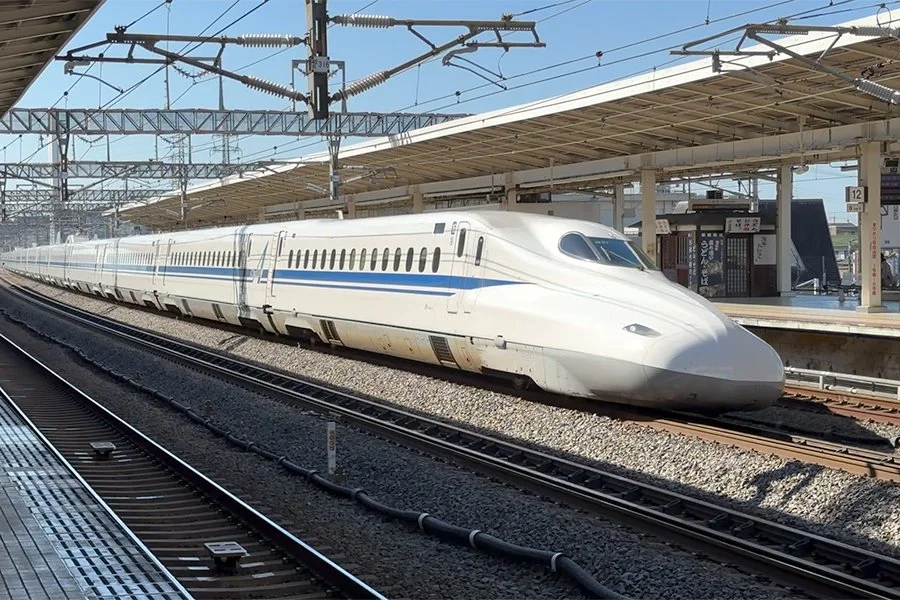
Figure 1: One of the Shinkansen’s trains at a station [3].
Since the time of its inauguration, the bullet train has proven a dramatic step forward in railroad safety, boasting no accidents due to its grade separation which keeps its tracks from intersecting with other, slower trains, and roads. Each line is monitored with Automatic Train Control signalling (ATC) which effectively tracks the trains positions, then decelerates or accelerates them accordingly to prevent crashes and exceeding speed limits. With collisions a near impossibility, ATC has influenced train designs to rely less on robustness to increase safety and instead emphasize the aerodynamics for which bullet trains are named in English [3]. Together with greater aerodynamics and decreased weight, bullet trains exhibit improved efficiency to their bulky counterparts.
Shinkansen routes are more direct, often cutting under, over, and through obstacles. The first line—or “new trunk line” from which the name Shinkansen is derived—impressively tunneled through approximately 67 miles (108 kilometers) of mountainous terrain to achieve as direct a route as possible and set the standard for future high speed lines [2]. Although the extra need for infrastructure increases construction costs, these popular rail lines pay themselves off relatively quickly by providing commuting service to 340 million passengers each year [4].

Figure 2: The current Shinkansen which traverses almost the entire island country [4].
Another advantage to high speed train lines is the economic stimulation that occurs around stations as well as residential development at locations further from urban centers. Convenient commuting offers greater incentive to urban workers to live in suburbs or even rural areas without increasing commuter traffic on highways [2]. For this reason, it did not take long for the concept of bullet trains to spread to Europe and more recently to China and Taiwan [5]. High speed trains have grown in use internationally through the years and have historically more than halved commute times [2]. The innovation in railways presented by Shinkansen has come to represent the value placed on punctuality and respect in Japanese culture, providing reliable and fast transportation that makes travel less stressful and more enjoyable [6].
REFERENCES
[1] “Shinkansen: 60 Years of High-speed Revolution.” National Railway Museum, 2024, www.railwaymuseum.org.uk/whats-on/shinkansen-high-speed-revolution.
[2] Haden, Jeff. “The Shinkansen: How High-Speed Rail Transformed a Nation.” High Speed Rail Alliance, 22 Sept. 2021, www.hsrail.org/blog/the-shinkansen-how-high-speed-rail-transformed-a-nation/.
[3] “The Shinkansen’s Legendary Operation and Safety Record.” High Speed Rail Alliance, 14 Oct. 2021, www.hsrail.org/blog/the-shinkansens-legendary-operation-and-safety-record-2/.
[4] “Japan’s Shinkansen Railway.” Science, Technology, and Society, Clemson University, opentextbooks.clemson.edu/sciencetechnologyandsociety/chapter/japans-shinkansen-railway/.
[5] “History of the Shinkansen: The Japanese Bullet Train.” JRailPass, 11 July 2023, www.jrailpass.com/blog/shinkansen-bullet-train-history.
[6] “Shinkansen: The Japanese Bullet Train.” We Build Value, 27 June 2024, www.webuildvalue.com/en/reportage/bullet-train.html.
To cite this article:
Bowler, William. “Shinkansen: The Bullet Train.” The BYU Design Review, 5 March 2026, https://www.designreview.byu.edu/collections/shinkansen-the-bullet-train.