
Empathy in Technical Communication: What? Why? How?
If you eavesdrop on any conversation I have with a student during office hours (pretend you are a fly on the wall or you have hacked my Zoom meeting room), chances are that 9 times out of 10 you will hear me ask the question: “Well, what does your audience need?”
It does not matter what part of the semester we are in or what assignment we have been working on in my advanced technical communication course—a common requirement for junior/senior STEM majors. Whether we are writing emails, literature reviews, or anything in between, my feedback almost always circles to one thing.
Empathy. The #1 reason points are lost, additional revision is required, or things just aren’t “working” is empathy—or, rather, a lack thereof.
Empathy is the first step in the design thinking approach, an iterative process for creative problem-solving which typically consists of 5 nonlinear steps: empathize, define, ideate, prototype, and test. For more on this, click here to access a short course on design thinking by Chris Mattson or read Ch2 of Jon Balzotti’s “Technical Communication” [1].
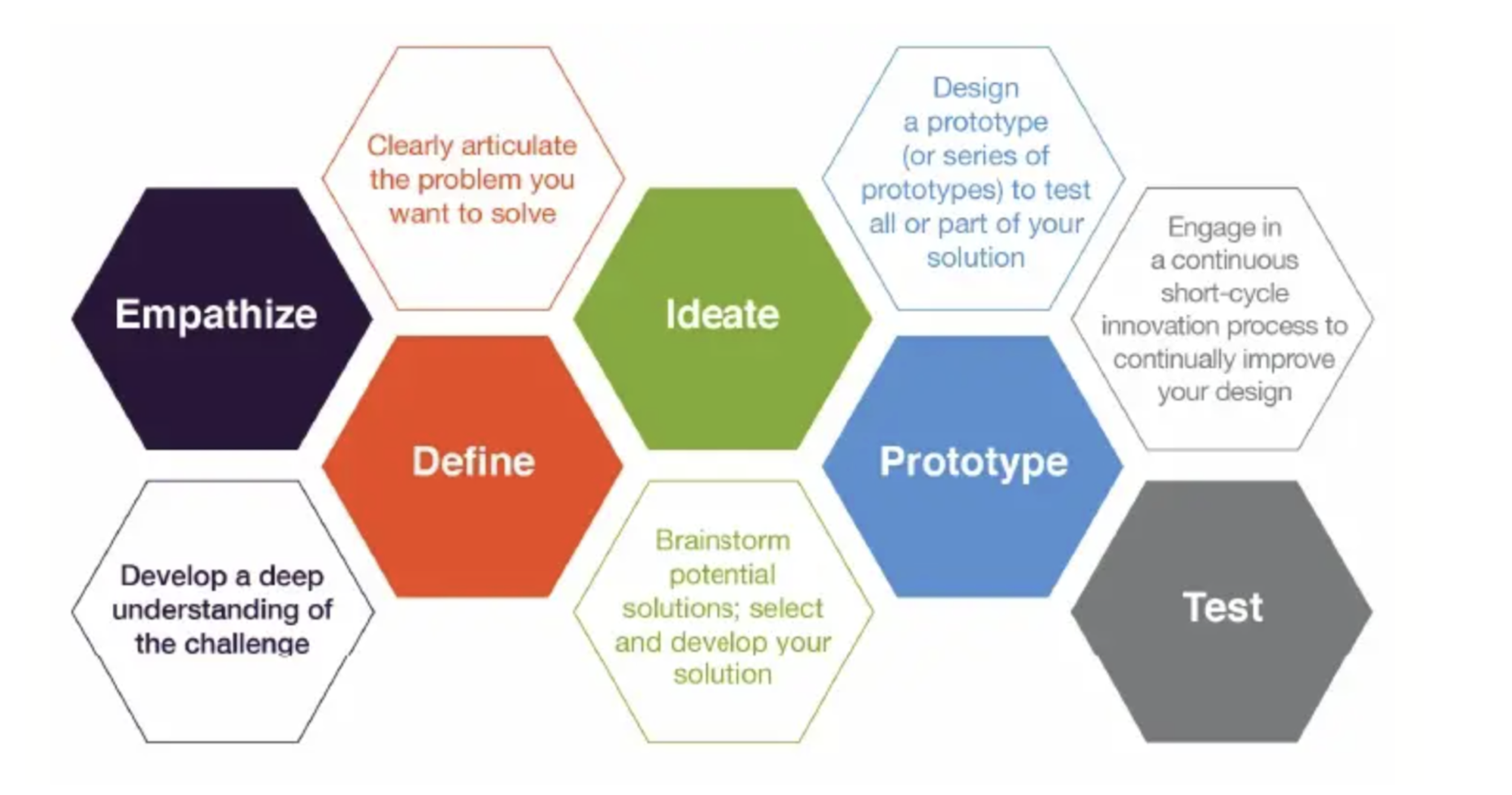
Figure 1. The 5 steps in the design thinking process are nonlinear and iterative, meaning you can move backwards and forwards as many times as needed until you reach a successful output [1a].
Now, you might be surprised that we utilize the same design thinking process applied to product development for technical writing and speaking contexts; however, the approach itself is quite similar to the traditional writing processes you likely learned (and subsequently forgot) every year throughout your K-12 education. What is prewriting if not ideating? What is a first draft if not a prototype?
That established, what makes the design thinking approach so effective for technical communication specifically is the way in which it prepares you to meet the needs of your end user. Whether designing a product or drafting a memo, the starting place should be the same. Empathy with your audience. As soon as possible.
The What
One of the reasons empathy is such a difficult concept to understand and apply is that there is no consensus on “what is even meant” by the term [2]. Some consider it an ability (considered innate; you have it or you do not) and others, a skill (a capability that can be acquired through training/experience/practice). While it is clear that some individuals are born with a greater natural tendency towards empathy than others, the considerable dialogue surrounding how to teach empathy to students, how to develop it through professional seminars and trainings, and how to learn it on your own point to empathy being a skill that can be learned and grown over time [1, 2, 3, 4, 5, 6]. Good news for us!
As far as what capability we are working to develop, most of the proposed definitions of empathy include an understanding of another person’s needs [1c, 2a, 5a, 6a] and add to it a demonstration of that understanding [2b, 5b, 6b]. Both of these elements sound simple and yet can be sneaky stumbling blocks for students and seasoned professionals alike.
Take, for example, a proposal for a new project: a technical genre that calls for both persuasion and information. From the writer’s perspective, you must give your end user the information they need to understand and evaluate the project (hopefully, in your favor). Being passionate about your idea, it can be tempting to include every interesting detail, historical timeline, or tangential piece of background info surrounding the topic of the proposal. After all, we want to know everything we can about this fascinating topic because we care about it. And because we care about it, every piece of information feels important. So, the more the merrier, right? What is a few extra pages in the scheme of things…
Unless you are the end user for the proposal. Your goal in reading, as the end user, is to decide whether to approve the project. To do this, you need to know if the project will be a valuable use of resources with a (hopefully) high chance of success. And, preferably, you would be able to establish the promise of the project thoroughly in as little time as possible so you can move on to other tasks, get home at a decent hour, and come one step closer to that ever-elusive work-life balance people keep talking about.
To the end user, a “few extra pages” of reading that obscure the main purpose with irrelevant or inaccessible information while simultaneously demonstrating a lack of respect for their time and energy is, in fact, a big deal. Intentionally ignoring or failing to accurately understand and accommodate the end-user’s needs makes the job of the end user more difficult while reducing the chance of success for the writer hoping to gain approval for their project. Lose, lose.
In summary, empathy requires us to prioritize meeting the needs of the end user even when it works against our own natural impulses. Removing “self-centeredness” [1c] from the equation, delaying our own assumptions, judgements, and biases in order to accurately assess a rhetorical situation from an audience’s point of view, is difficult, but ultimately leads to benefits for both end user and communicator…
The Why
…which brings us to the why: empathy benefits the communication itself and the communicator(s) more broadly.
Improved Communication
Empathy in technical communication is linked to improved quality and effectiveness. If the above example is not sufficient to prove this point, we can look to Bray et al.’s 2012 study that identified elements essential to effective scientific communication. Half of the top-ranked elements involved empathy with or understanding of the audience, with “audience participation, audience trust, respect for audience, audience needs, audience outcomes, and audience imagination [being] elements that were reiterated throughout the study” [3a].
Improved quality via empathy is especially visible in contexts that work to serve multiple audiences with varying needs simultaneously (groups with different purposes in reading or approaching the text from distinct backgrounds). While design-thinking is not an inherently “inclusive approach” [4a] (there can be a tendency to oversimplify who our audience is for the sake of ease or simplicity), a thorough empathizing stage that considers all audiences without discounting outliers or minorities from the very beginning of a project can guide us towards deeper solutions or means of communication that reach further for greater impact.
Improved quality is not limited to written communication either: “Empathy has been found to be an asset during negotiations and to increase creativity in teams, enhance cooperation, raise employee commitment, and strengthen leadership abilities” [6c]. All manners of communication, formal and informal, within and outside of organizations, can be improved through empathy.
Benefits to the Communicators
Bigger picture, we see the benefits of empathetic communication ripple outward into other aspects of the communicator’s professional life. For one, efficiency. While some may see empathy as an extra step that slows down the completion of a project, accurately empathizing with your end user from the start of a process can reduce the number of iterations needed to achieve a project that sufficiently accomplishes the purpose of communication [1d]. Less revision = less work. Woohoo!
Efficiency and the previously discussed increased quality of output could be two reasons empathy in technical communication appears to be a main factor of professional advancement. In Fuller’s 2021 survey of experts across professional disciplines, the participants identified empathy as “a critical professional competence…[that is] foundational to their professional success” [6d].
And the high demand for empathetic employees is not likely to change, as empathy is one element that cannot currently be outsourced to Artificial Intelligence (AI). Getto et al. explain, “[l]anguage models alone lack awareness of… the purpose, context, and outcomes of the content they generate. While this makes them highly flexible, it also makes them prone to misrepresenting information or misunderstanding critical nuances. Humans, therefore, remain essential for determining writing goals (context and exigence), structuring the workflow, managing each step, and ensuring the overall quality and effectiveness of the final product" [7a]. The thorough detailing of the rhetorical situation Getto et al. describe, especially the audience(s) and their needs respective to the context of the design task, is vital to drafting prompts that will achieve a quality output from current AI programs. In other words, empathetic employees are key to effectively and efficiently harnessing the generative power of AI, a common goal across industries.
The How
So, the what and why covered, how do we do it? How to become an in-demand empathetic employee? How to put empathy into action to craft technical communication that meets the needs of audience(s) quick as can be? Recommendations, strategies, and tips abound. Take your pick:
Empathetic Skills to Develop
Active listening (listening to understand, not speak) [6e]
Checking understanding through paraphrase [6e]
Asking questions [1e, 6e]
Cultural Awareness [1f, 6f]
→ Watch: Click here for a video on avoiding miscommunication that discusses many of the above skills.
Methods for Gathering Audience Data
Research and case study analyses [1, 3, 6]
Observations and survey data of real end users [1, 6]
→ Tip: How interactions with users are designed "is crucial to the kinds of data they collect and, later, to how the data are analyzed and used to support design work" [4b]. Cultivating a comfortable environment includes location, seating arrangements, technology use, manner of dress, etc. [6g].
Role play [3, 6]
Productive failure [4] → the least likely to reduce the number of prototypes needed, but a fabulous learning tool nonetheless!
Organizing and Sorting through Audience Data
Research matrices → used commonly for literature reviews, but I find them helpful here too.
Compile into a user need statement [1g]
There you have it! A non-comprehensive but research-backed bit of the what, why, and how for empathy in technical communication. Becoming an empathetic communicator is not easy or quick, but, as I assure my already overworked junior and senior STEM majors over and over throughout each new semester, intentionally striving to develop an empathetic skillset and consciously applying it to each new rhetorical situation will gradually turn the uncomfortable new into familiar habit. The more you do it, the easier it gets. And the benefits are worth it.
So, who is your next audience? Why are they reading? And how can you make it easier, faster, and more effective for them? Hopefully, even without making an appointment during office hours, you know exactly where you should start…
References
[1] Balzotti, Jon. "Design-Centric Communication." Technical Communication. Routledge, Taylor & Francis Group, New York, NY, 2022.
[1a] pg. 31
[1b] pg. 16
[1c] pg. 16
[1d] pg. 23
[1e] pg. 19
[1f] pg. 20–21
[1g] pg. 23
[2] Bollen, Caroline. "A conceptual and ethical framework for empathy and communication technologies." Technology in Society, vol. 79, 2024. doi:10.1016/j.techsoc.2024.102707.
[2a] pg. 3
[2b] pg. 3
[3] Bray, Belinda, et al. "Identifying the Essential Elements of Effective Science Communication: What Do the Experts Say?" International Journal of Science Education, Part B: Communication and Public Engagement, vol. 2, no. 1, 2012, pp. 23–41. doi:10.1080/21548455.2011.611627.
[3a] pg. 36
[4] Greenwood, April, et al. "Dissensus, Resistance, and Ideology: Design Thinking as a Rhetorical Methodology." Journal of Business & Technical Communication, vol. 33, no. 4, 2019, pp. 400–424. doi:10.1177/1050651919854063.
[4a] pg. 402, 406
[4b] pg. 406
[5] Rodman, Lilita. "You-Attitude: A Linguistic Perspective." Business Communication Quarterly, vol. 64, no. 4, 2001, pp. 9–25. doi:10.1177/108056990106400403.
[5a] pg. 11
[5b] pg. 11
[6] Fuller, Melissa, et al. "Conceptualizing Empathy Competence: A Professional Communication Perspective." Journal of Business and Technical Communication, vol. 35, SAGE Publications, 2021, doi:10.1177/10506519211001125.
[6a] pg. 336
[6b] pg. 336
[6c] pg. 336
[6d] pg. 340, 343
[6e] pg. 343
[6f] pg. 345
[6g] pg. 348
[7] Getto, Guiseppe, et al. "How to Write With GenAI: A Framework for Using Generative AI to Automate Writing Tasks in Technical Communication." Journal of Technical Writing and Communication. SAGE Publications, 2025, doi:10.1177/00472816251332208.
[7a] pg. 19
[8] Ta, Vivian, and Brian Lande. "Empathy: What Is It, Exactly?" Police Chief Online, 19 Oct. 2021, www.policechiefmagazine.org/empathy-what-is-it-exactly/.
To cite this article:
Arana, Elena. “Empathy in Technical Communication: What? Why? How?” The BYU Design Review, 10 December 2025, https://www.designreview.byu.edu/collections/empathy-in-technical-communication.